
Việt Kiều n.
Vietnamese Sojourner
Overseas Vietnamese; a term referring to Vietnamese people residing outside the territory of Vietnam. They may be holding Vietnamese nationality or/and the nationality of the host country.
There are approximately 5 million overseas Vietnamese, the largest community of whom live in the United States. See also: người Việt hải ngoại or người Việt Nam ở nước ngoài.
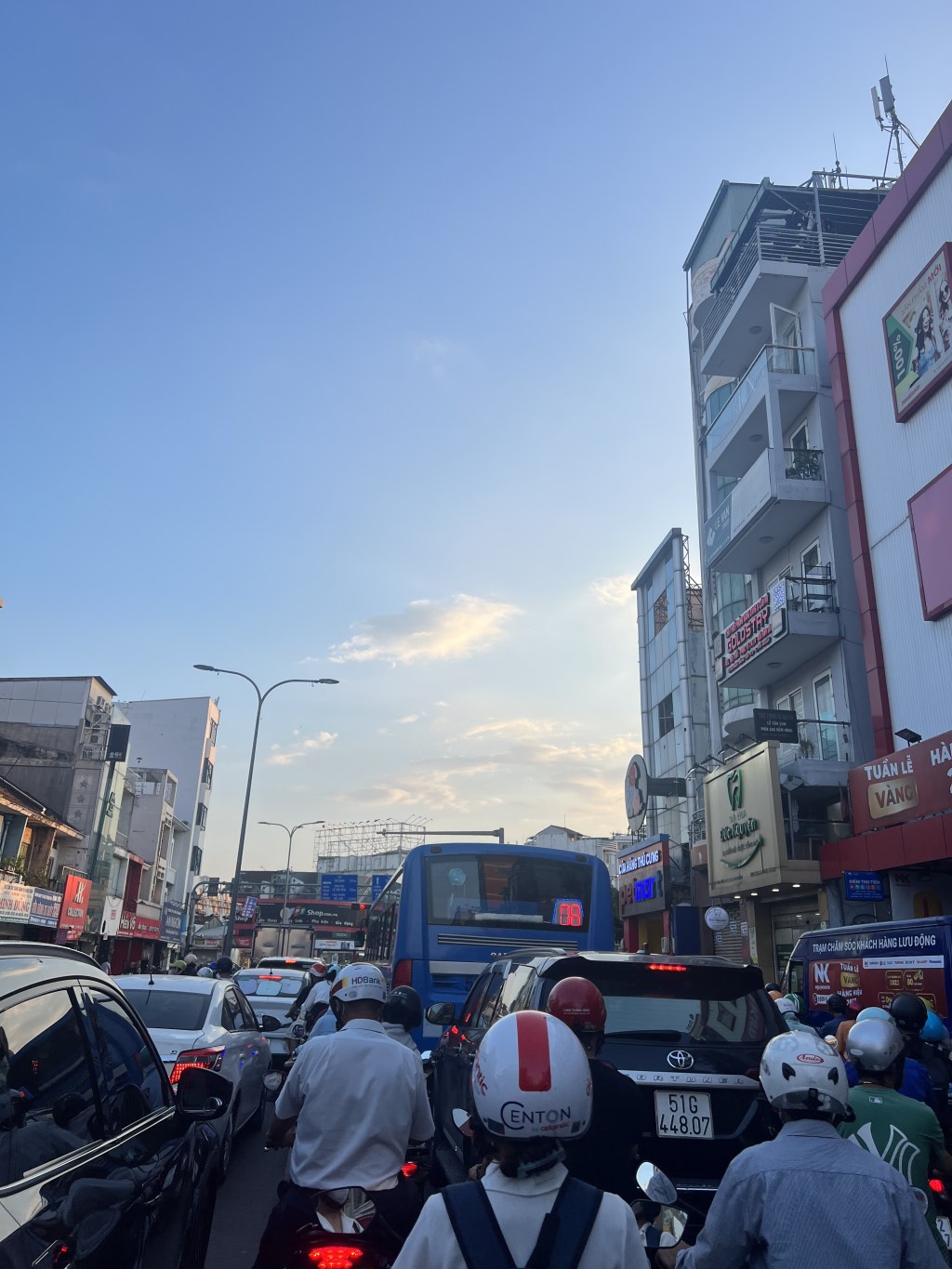
I’ve been getting quite a few strange looks here in saigon. inoffensive looks, but invasive looks nonetheless. the drivers do a bit of a double take when they come to pick me up from the corner of the street and I greet them in vietnamese. the lady selling bánh cuốn from the metal cart stares me down from across the alleyway, as if sizing me up to determine whether or not I have the guts to eat her street food. they look at me as if they might know me. as if I could be their cousin’s daughter or maybe a family friend who came over for dinner once.
but there’s always something that gives it away: the tan of my skin or the sunspots on my face, the way I grip the seat of the motorbike until my knuckles turn white, the slight lilt of a stammering american accent that is punctuated with “uh’s” and “like’s.” once their suspicions are confirmed, they almost always immediately spot me for what I am: việt kiều.
without having to say a single word, my face and my foreignness are enough to invoke a complicated story of a divided country. a story of war and conflict and division. a story of a people who fled their homeland because of hatred and terror and resentment and hope for something better. in their eyes, I am the daughter of the prodigal son who left home but was always just a little too stubborn and a little too prideful to come back.
you see, the term việt kiều was originally meant to only describe this specific group of people. the families from the south who fled vietnam after the fall of saigon, after the rise of communism, after the political persecution, after the reeducation camps. the term refers to the fishermen who held their breaths as their wooden boats packed tightly with women and children lifted from warm sandy shores and into the cold night in hopes of finding land somewhere across the pacific ocean.
and so I think the term is an interesting one: vietnamese sojourner. it implies that this is only a temporary residency—as if it’s only a matter of time before the naughty children come running back home to mother.
and yet, the opposite has occurred: the vietnamese diaspora has firmly established itself as a force of nature in cities across the globe. in cities like san jose, paris, houston, melbourne, saxony, they have built little saigon’s, formed political coalitions, and started families. these sojourners have forged for themselves a permanent home.
and so I think that’s part of why I am such a puzzle to the people of saigon. I do not look like the family members they once knew, nor do I look like the americans you see in movies. I am something a bit different. they look at me with a certain excited confusion, because they see me for what I am: I was born and bred in the united states—raised on GMO-pumped milk, reality tv, and mcdonald’s chicken nuggets—and yet, I am vietnamese.
you know, I’ve never been able to fully get behind the anger surrounding the notorious microaggression of a question: “so, where you really from?” (apologies in advance for this piping hot take, but in the evolved year of 2023, I think that we’re capable of demonstrating respectful interest in our peers’ ethnic origins without having to make a fuss. but, I digress. ) I think it’s a question that feels especially harmless to me because I think that our american conception of being from somewhere is too loosely defined in the first place.
of course, whenever people ask me where I’m from, I have my canned response prepared: from seattle, but went to school in the bay area—west coast, best coast!! and I think this is the natural inclination for most of us when we think about where we’re from. we are a country of folks who rep our states proudly, wear our alma mater colors long after graduation, and spend our sunday’s cheering for our football teams. when we think about where we are from, we think about the town where we grew up. we think about the mall with the ice cream shop or the restaurant we would always go to after church.
but I can’t help but wonder if our american attachments to land—attachments to our places of belonging—are too superficial. I wonder if we can ever feel genuinely from somewhere if the place where we’re from is a place that just happened to be where your parents or grandparents or great grandparents bought a house a few decades back. it’s difficult to feel like you’re really from somewhere in a society where young people move out and away from their families at the green age of 18. I can’t help but to suspect that it is especially difficult for a society made up of non-indigenous residents to have much of an attachment to land that isn’t entirely characterized by capitalist consumption (see: the commodification of leisure and our retail-built environments).
in Braiding Sweetgrass: Indigenous Wisdom, Scientific Knowledge, and the Teachings of Plants, Robin Wall Kimmerer describes what it means to truly belong to a place:
“Being naturalized to place means to live as if this is the land that feeds you, as if these are the streams from which you drink, that build your body and fill your spirit. To become naturalized is to know that your ancestors lie in this ground. Here you will give your gifts and meet your responsibilities. To become naturalized is to live as if your children’s future matters, to take care of the land as if our lives and the lives of all our relatives depend on it. Because they do.”
how often do we think of the place we are from as a place where we have poured our entire souls into nourishing? how many of us have experienced the intimate reverence of knowing that your ancestors walked the same grounds that you walk? when we move to a new city, are we thinking about the reciprocal relationship that our descendants will need to have with the land in order to continue feeding and nourishing her long after we are gone? our inability to have this reciprocal and respectful relationship with the land on allows for these places to become commodified objects of consumption—objects that can and will be deforested, demolished, and gentrified for the same of making something cooler, flashier, and more expensive. I mean, let’s be honest, no one wants to say that they’re from the small town where the only thing to do for the summer is to go to the waterpark; it sounds much cooler to say you’re from seattle than it is to admit that you’re from renton, washington. the temporality and conditionality of our relationship to land makes it so that the place where you’re from becomes a mechanism of accumulating social capital, rather than an authentic representation of your humanity. we have made ourselves sojourners in our own homes.
I spent my childhood moving from apartment to apartment with my mom and little sister. we found ourselves sojourning from iowa to china to washington to god knows where next. I don’t know that I’ve ever felt quite at home anywhere I’ve settled. maybe that’s the plague of an unstable childhood. maybe it’s the plague of diaspora. or maybe it’s the plague of american capitalism.
and yet, somehow, as soon as I landed in saigon—as soon as I felt the exhilarating wind of motorbike rudely cutting me off while I was walking on the pedestrian path, or when I went to bed and could still smell the stain of fish sauce in my hair from the dinner my aunt cooked for me—I knew there was some part of me that was from here.
the strange look that strangers greet me with here is always accompanied by a very familiar question: em đến từ đâu? where are you from?
and I get excited every time to tell them: I am from america! but I am vietnamese!
and they always respond with an amused smile: em đã về thăm, hả? so, you’ve come home to visit?
in the month that I’ve been here, I’ve been met with open and generous arms. my family members whom I had never known before this summer make a place for me at the dinner table each night. the taxi bike drivers ask me questions about the places I’ve traveled and my life in the states. the women at the food stands poke fun at my broken vietnamese but feed me extra pieces of meat without me even asking. even though I am a stranger, I am a sojourner who came home to them.
my aunts are bewildered by the person that I am—a young girl traveling the world alone—as if they could not believe that their own flesh and blood could become a creature like this. and the longer I stay here, the more I realize how different I am from the other vietnamese people who live here. but I’m also coming to realize the ways that I’ve been from vietnam all along. I’m recognizing my mom’s aesthetics throughout the city, I’m seeing my aunts’ faces in the strangers I see on the street, I’m hearing my grandma’s voice in the tone of ladies selling me fruit, I’m realizing my own practical and chaotic nature is the energy that runs through the spirit of the city.
I’ve been craving this place in ways that I didn’t even know that I could. I’ve spent my entire life missing this city for things I never even knew existed. and while I don’t think we’ve yet to stumble upon a perfect definition of being from a place for a post-colonial and diasporic world, I think it has to do with being able to miss it. to miss the people, the land, and the feeling it provides you. and to be able to say that, when I return, there is going to be someone or something that will welcome you with open arms. to tell you that you’ve come home.
 nhiều chuyện, by angel lin