
I grew up on paris by night and heineken. I took my first steps in a basement that hid a secret double life as a karaoke bar. I knew neon flashing lights and the sound of a microphone feedback before I knew the disney princesses.
on whatever spontaneous sunday night the aunts and uncles were able to come home early from their shifts at the nail salon, restaurant, or casino, it could be safely assumed that the night would end in wailing duets with beer devastatingly spilled onto the corner of the couches and neon lights flashing into revolving patterns across the dark room in tune with the music. the children would be fast asleep on the ground or in the laps of their parents who combed their fingers through their hair with one hand and held the microphone high to their mouths with the other. the screen would be lit up with music videos from a period lost in time taking place somewhere between the American 70’s and the Vietnamese 90’s (those familiar with the topic will know that these two time periods are not as different as they seem). the youngest aunts dancing along to the latest, sexiest global pop sensations minh tuyết and trish while the grandfathers croon to an old song about being separated from their first love by the seventeenth parallel. our families greedily clung to these cultural artifacts like they were their life source. their last hope of keeping their rope taut to their country, one whose aquaintance they have not known since the 1975.
imagine! the country where they imagined spending their entire lives: where they fantasized their high school experiences, their wedding engagement, their firstborn child, their first kiss, their last kiss. a future envisioned but dissipated after 1975. I mean, what is it to even imagine a life outside of your own country? to suddenly be told that you were to live in the united states. to entertain the potential that, one day, you may never return to the home of your mother and grandmother and great-grandmother. to enter a world you only knew in overheard rumors and half-truths. to raise a child in a society you only knew through through guarded defensiveness and jaded disappointment.
but I digress.
oh, but what an artifact to have: karaoke. a wonderful thing, really. not quite art and not quite performance but entirely an experience of joy. what a most genuine feeling to have. to exist with your family and want to create entertainment with one another for one another. and how can one help but sing when your language is made alive by soaring and dipping tonal variations that reverberate the walls (so dramatically different from the drawling monotone repetition of english). what a perfect nostalgic escape. an emotion I cannot even begin to imagine: to be homesick and heartbroken for your country. heartbroken as if it were a lover you were separated from for no logical reason other than identity and war and politics and borders and wealth and poverty and—
the vietnamese are a prideful people—not one to admit that they miss the country they were forced out of. it’s arguably much easier to sing your laments about the loss of a lover.
for anyone unfamiliar with this era of 2000s vietnamese media, let me elucidate the scenario. you see, when your country has a communist revolution and your people are on the losing side of a civil war and forced to relocate to different pockets of inhabitation across the world, consuming the music of the people who kicked you isn’t exactly appealing… but how can you keep from singing? in 1983, vietnamese parisian immigrant tô văn lai sought to fill this cultural void experienced by vietnamese americans brought about by the diaspora. with other refugees in france, he created paris by night: a variety show complete with musical performances with flashy dancers, sketches reminiscent to the era of vaudeville, orchestras featuring the stylings of a guqin, and a cast of stars who have become household names familiar to any young vietnamese american. the direct-to-video episodes entered the hearts and homes of vietnamese refugees across the seas as they churned out over 130 (and counting) three-hour-long episodes the course of 30 years.
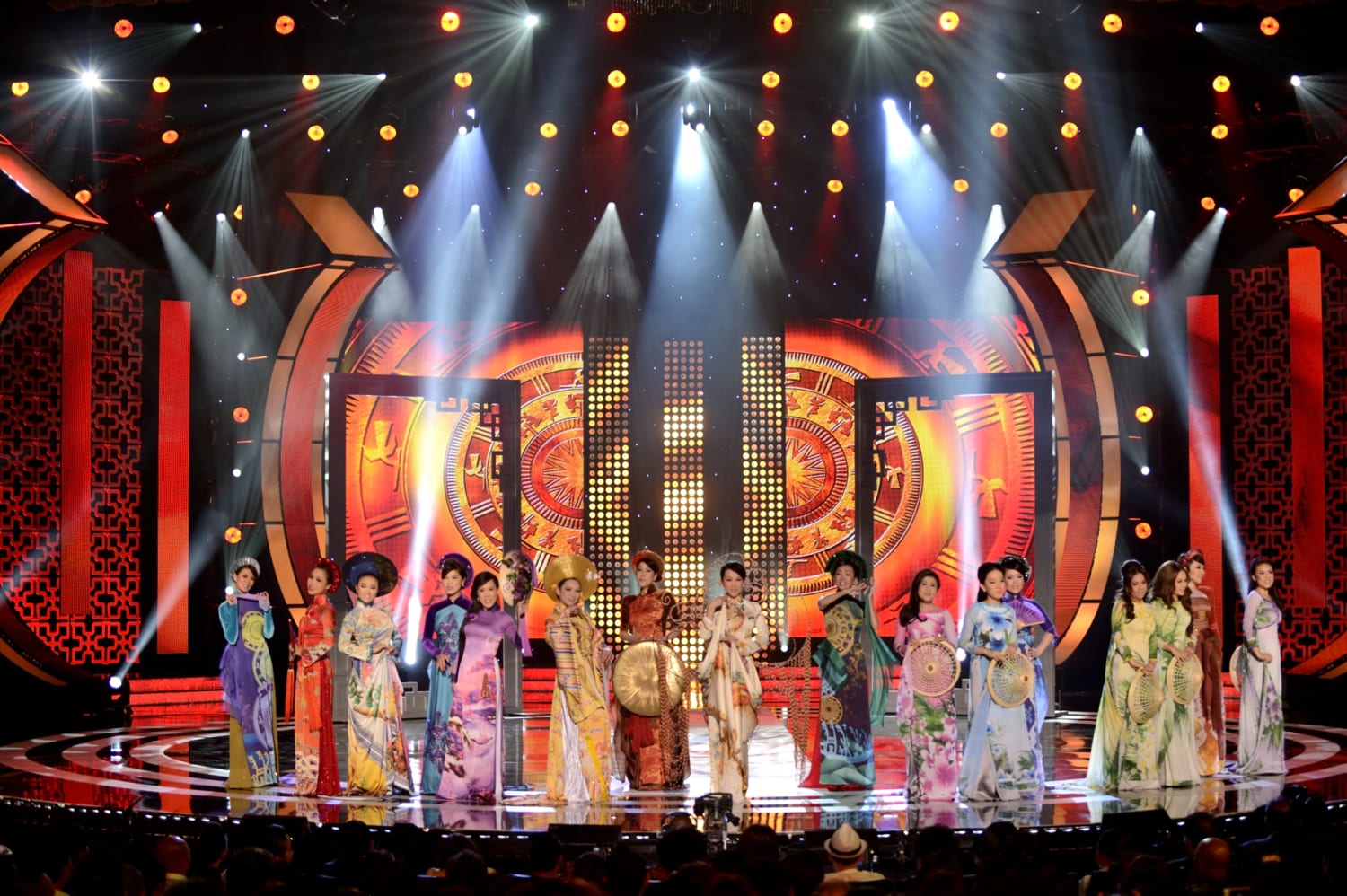


as with all things vietnamese american, the show has been fraught with controversy. alongside the comedy sketches about deadbeat husbands and pop performances dripping in sex-appeal, the show often features performances providing direct commentary on the political state of vietnam. in 2004, hoang oành performed a song entitled “về đây anh” (translating to “come home, husband”) about northern vietnamese fleeing to the anti-communist south during the partition of vietnam only to be met with imprisonment. paris by night 77 commemorated the 30th anniversary of the fall of saigon with montages criticizing communist rule and human rights’ violations, featuring a performance by như quỳnh entitled “đêm chôn dầu vượt biển” (“the light burning across the sea”) which highlighted the perilous journey of vietnamese refugee boat people. the program is banned in modern vietnam but consumed by hundreds of thousands of overseas vietnamese on every continent.
these were the songs we sang to one another in our basements. the songs honoring victims of the huế massacre and verses praising america’s role in the vietnam war were my history lessons. my african amerasian uncle bellowed songs about separation and identity while I heard whisperings amongst my cousins about his unknown father. my grandfather belted his memories of the countryside while gripping the microphone with a right hand that lost partial movement to a piece of flying shrapnel.
the only hints of the american occupation’s violence were the dancers dressed in costumes resembling american soldiers running across the stage. the only indications of colonialism’s scraping of culture were the romantic trumpet entrances to the love songs composed in the style of french sonnets. the only images of agent orange’s devastation were the commercials that flashed between songs that called for donations to the orphanages housing the thousands of children born with birth defects as a result of american bioterrorism.
my family still sings these songs today. I still sing these songs today. when I perform them at the vietnamese senior center’s karaoke social, the elders praise me for being such a great vietnamese singer, despite being american-born. but I don’t sing lyrics in vietnamese; I sing in the lyrics of the vietnamese diaspora. I can’t help but wonder what my participation does to the legacy of american occupation. what connection do I really have to my culture if the only one I know is defined by opposition and heartbreak?
this fall, I will be studying abroad in paris. I will be going to the site of this vietnamese american identity’s conception. I hope for the opportunity to one day determine what the diaspora means to me, what the lingering whispers of american occupation are saying to me, and what paris by night looks like with my own eyes.
Song Recommendations
PBN 77 | Như Quỳnh – Đêm Chôn Dầu Vượt Biển – YouTube
Phi Nhung – Chuyện Làm Dâu (Võ Thiện Thanh) PBN 63 – YouTube
Vầng Trăng Khóc – Nhật Tinh Anh ft Khánh Ngọc – MV – YouTube
Solo cùng Bolero Vũ Khanh & Ý Lan Khi Người Yêu Tôi Khóc – YouTube
Bằng Kiều & Minh Tuyết – LK Yêu Thuơng Mong Manh & Xin Lỗi Anh | Music Box #28 – YouTube
 nhiều chuyện, by angel lin