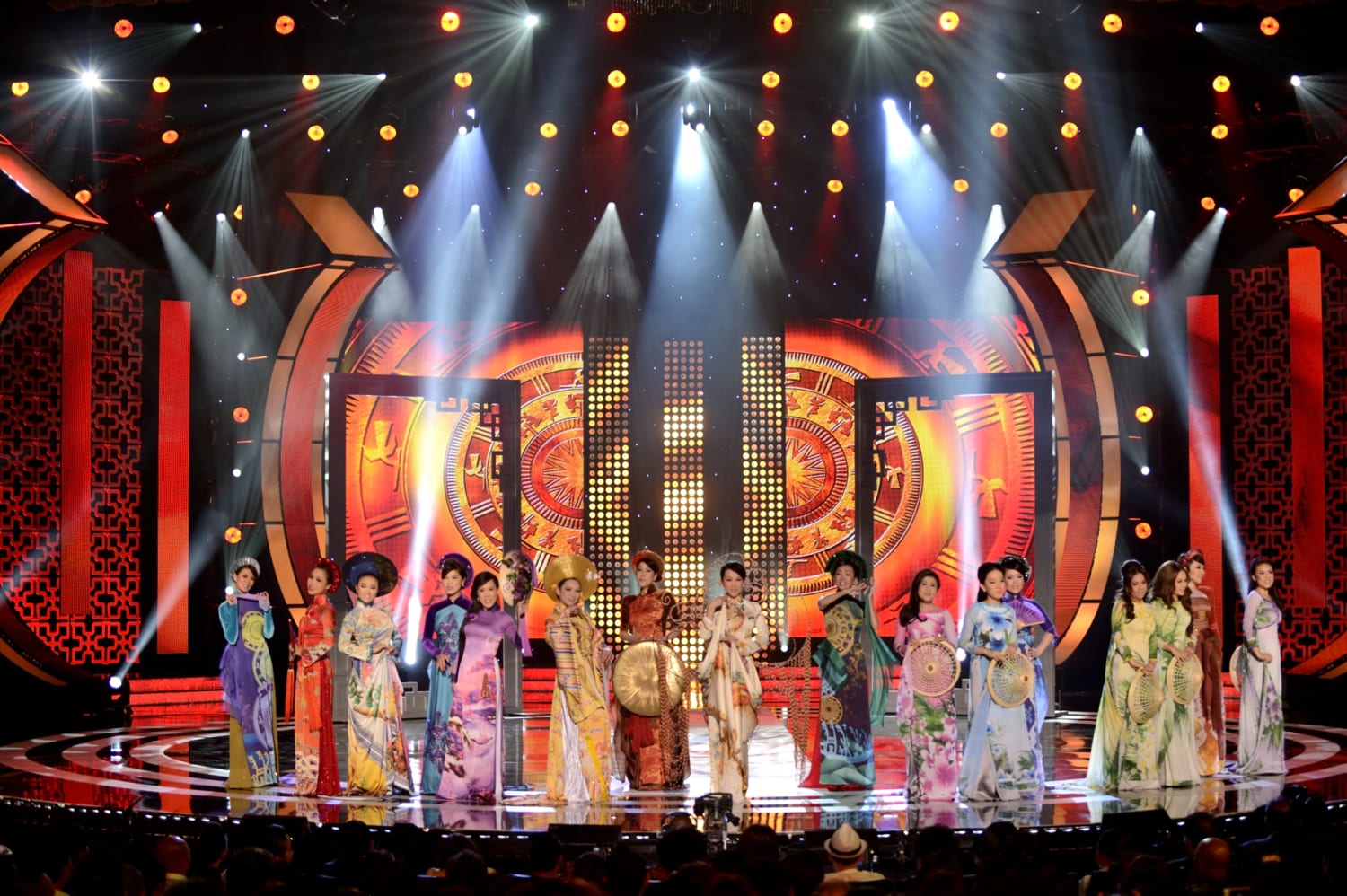
• this past june, I graduated as valedictorian of the class of 2023!! just a first-generation woman of color doing things right… no biggie.

    after some reflecting, I realized that this was an event I wanted to celebrate, document, and immortalize on this silly little blog. here’s a link to the video if you are so inclined to watch how the speech played out. aside from a majorly embarrassing hair malfunction that doesn’t get resolved until about halfway through, I thought it went pretty well. definitely a moment I’ll be telling my kids about 🙂

    Hellooo, Class of 2023!

    Can you believe it? We’re here! I mean, finally. It’s hard to believe that we stepped foot on this beautiful campus four years ago? I don’t know about you, but in 2019, I was still rockin with an obscene side-part and skinny jeans. And you know when you’re a teenager and you think you have the whole world figured out? And it’s cool to act like you hate everything? And then, all of a sudden, you’re off to college and you’re all like see you never mom and dad!

    Well, then you go to campus and then you meet these orientation leaders that are smiling a little too widely and everyone’s like super nice and the professors are actually the sweetest people ever and the flowers are blooming and the sun is shining you can’t help but start to suspect that the Jesuits might be pumping laughing gas into our water supply. Maybe it was just me, but as a jaded Seattleite who was used to overcast days and good old fashioned seasonal depression, Santa Clara just felt like a big love fest. 

    Now, I don’t mean this with a drop of irony. Here at Santa Clara, we’re just really nice to each other. We hold the door open for strangers, we collaborate to help each other study for tests, our classes are small enough to know everyone by name, we share internship and job opportunities like they’re falling from the sky—and, trust me, you and I both know that they are not falling from the sky… I mean, come on—all this lovey dovey business all this on top of the perpetually sunny skies and palm trees? At some point, it gets a little corny, right? You start to wonder, what’s the point of all this? 

    And, to be honest, I dont think I ever really understood it. At least until it wasn’t there anymore. You see, before we even had a chance to finish our first-year meal points or attend our first spring quarter dayger, the pandemic hit. And, well you know what happened next. It was a time of isolation and tremendous loss. It was a time that revealed the worst in our institutions. But it was also a time that revealed the best in our community. 

    Yeah, maybe the zoom classes were life-draining and you spent more time watching your professor figure out how to screenshare than actually learning. But do you remember those few times when you were assigned into a breakout room and it was actually really nice? When someone cracked a joke and everyone laughed and you all got to chatting and, for a brief moment, you were connected to these people and Santa Clara again? Or when you attended a MCC gen meeting over zoom and you got to meet all these new and eager first-years who wanted to be involved so you were like, why not play Among Us for the thousandth time? 

    You know, a statistic came out from an SCU wellness survey that year that showed that, during the pandemic, student-run RSO’s were the main source of creating feelings of belonging for SCU students. When we couldn’t find community in our classes or our residence halls or in Benson, we found it in each other. We were the ones dedicated to staying connected and stoking the love that fuels our community. Distance makes the heart grow fonder, I guess.

    But the really inspiring thing was when we came back to campus. After finally joyfully reuniting with my six beautiful brilliant best friends, I looked around and saw something familiar that we all shared in our faces. We were a bunch of overgrown first-years who had spent the last two years cooped up inside and, all of a sudden, we were juniors who had all of these underclassmen now looking up to us. To be directors hosting events we had never even attended before, to make huge decisions for the future of our student organizations, to lead research projects despite having major imposter syndrome, to be student body vice president. 

    But the thing is, we did it. We rose to the occasion. And we did it so well. We rebuilt the communities that were once separated. We showed the underclassmen what it meant to be a Bronco. We honored the legacy of traditions left by the upperclassmen who came before us. We burned some couches. 

    But, to me, what was most inspiring, was that we became advocates. When our campus was struck with tragedy, we demanded better mental health resources. When our school voiced a commitment to DEI, we called for more resources for students of color. When our communities were torn apart by violence, we developed better student safety and violence prevention methods. We were leaving the campus even better than how we found it. 

    Well, after spending some time warming up to the idea, I think I get what all this lovey dovey business is about now. You see, black feminist theorist bell hooks wrote in a little book called All About Love about this very specific type of love that I think I’ve been seeing here at Santa Clara. 

    She talks about the importance of fostering love as the impetus to radical action. What does that mean? Well, think about a love that is generous and far-reaching. A love that makes you smile at the people you don’t know when they pass by. A love that makes you excited to see your friends or your favorite professor in class the next day. A love that makes you more empathetic to yourself and others. bell hooks says that, when you let this type of love generously into your life—when you learn to love your friends, your neighbors, your community, and, most importantly, yourself—when you really let yourself love in those ways, you begin to be more attuned to the needs of those around you. Loving your community means being an advocate for your community. You want the best for everyone and everything around you so you’re willing to do what it takes to make sure that everyone is well taken care of. Growing up, my mom would always say this one phrase to me at the dinner table that I think reflects this well: “con ăn, má đã no rồi.” Watching you eat makes me feel full. And here at Santa Clara, we want to make sure everyone eats. 

    That’s why we advocate. Radical love is what makes us work so hard to build a legacy that makes sure that SCU students will continue to be taken care of, long after we are gone. 

    I’m a first-generation college student. I’m from a city where we have overcast skies three out of four days of the year and, before this, I had never seen a palm tree in my life. Four years ago, I would have never thought that I would have found the loving home that I found in Santa Clara today. But that’s what we do—we build loving communities. Communities where we can be cherished in our most authentic selves. Communities like LEAD where I met my beautiful brilliant best friends who teach me every day that I can expand my capacity for love. 

    My hope is that we grow only more abundant in our empathy, to the point where we can extend this love beyond the scope of this community. That we can love indiscriminately so that every single person and creature and life form on earth is something that we feel compelled to fiercely advocate for. I mean, that’s the Santa Clara mission after all, isn’t it? To use our education—our radical empathy—for good. To take care of one another. 

    Things look a lot different than how they did when we first got here. We have a woman president! Our student body is so much more diverse than it once was. I’m not wearing my hair in a side part anymore! We have new organizations and leaders and traditions. Our campus is a lot better than how it was when we first came to it. And I like to think that we played a big role in that. 

    We’re older, kinder, and more empathetic than we used to be. And, now, we’re prepared for the worst of it. Because, at a certain point in your adult life, bad things will happen. Possibly even unprecedented, pandemic, global-lockdown bad. But probably not. Just make sure that, when they do happen, you have someone to hold onto. Make sure that you’ve loved generously and created the relationships that will get you through it. 

    Live in community authentically, laugh loudly, love generously, and advocate for the ones you love fiercely. Congratulations, Class of 2023.
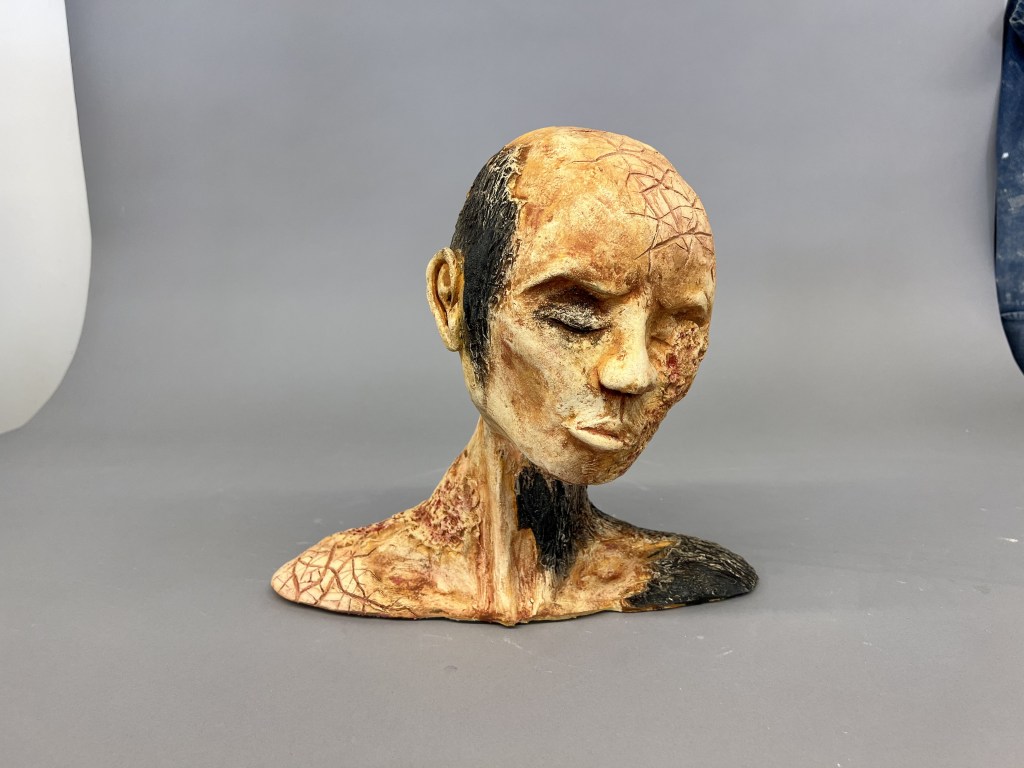
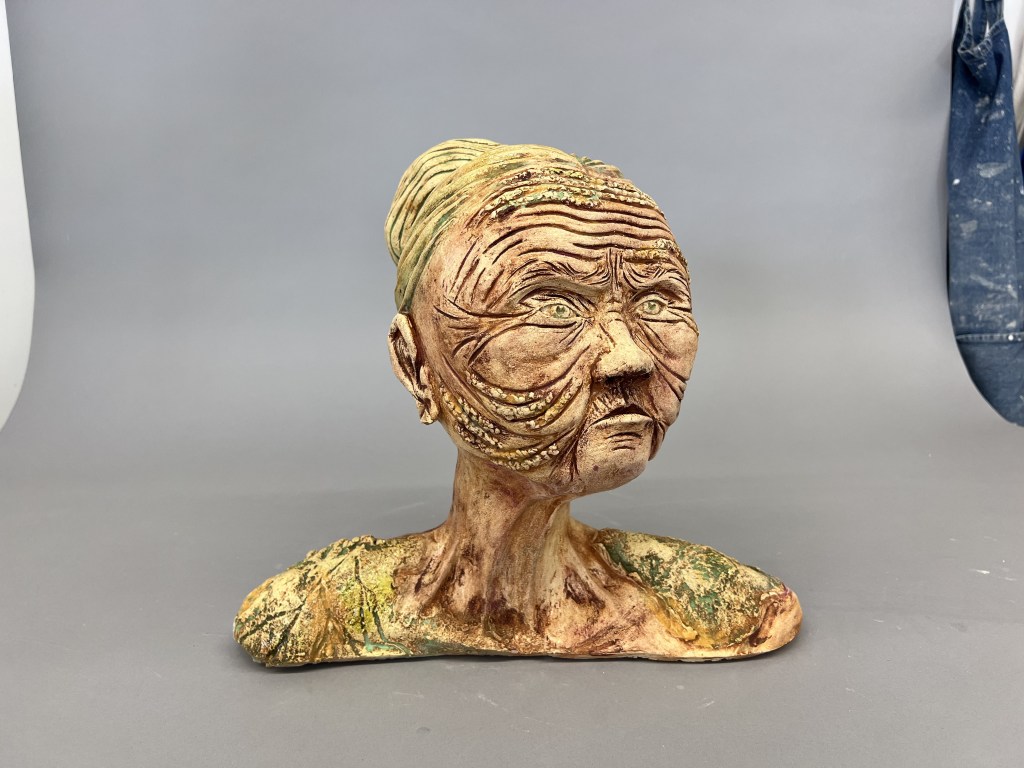
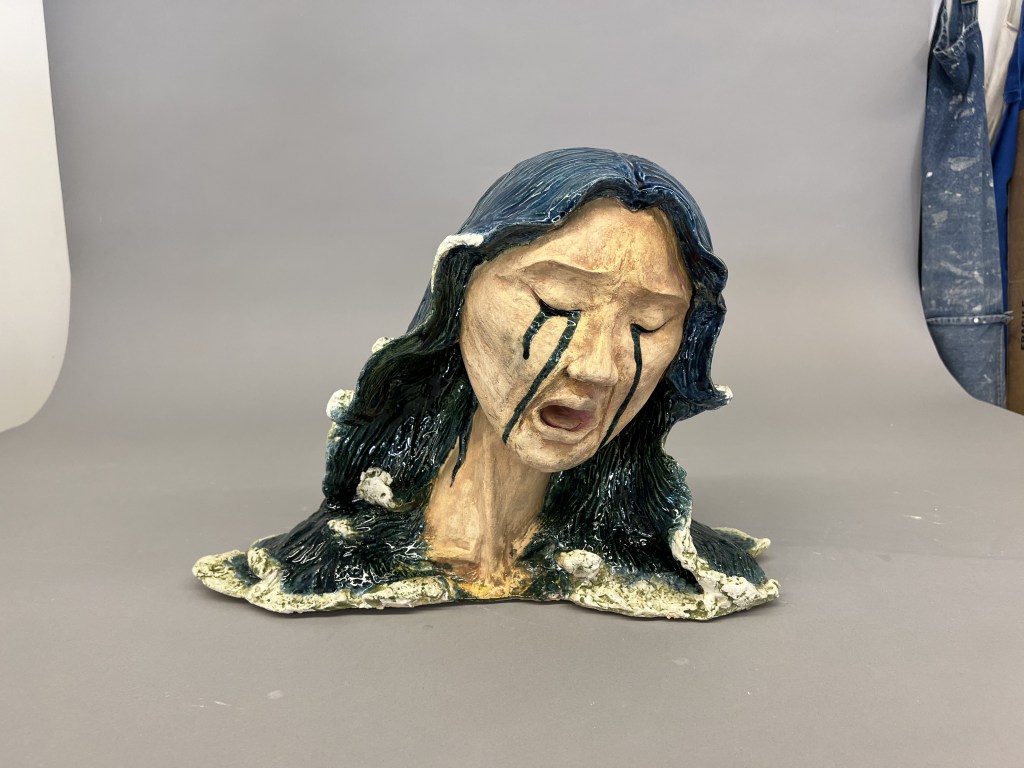
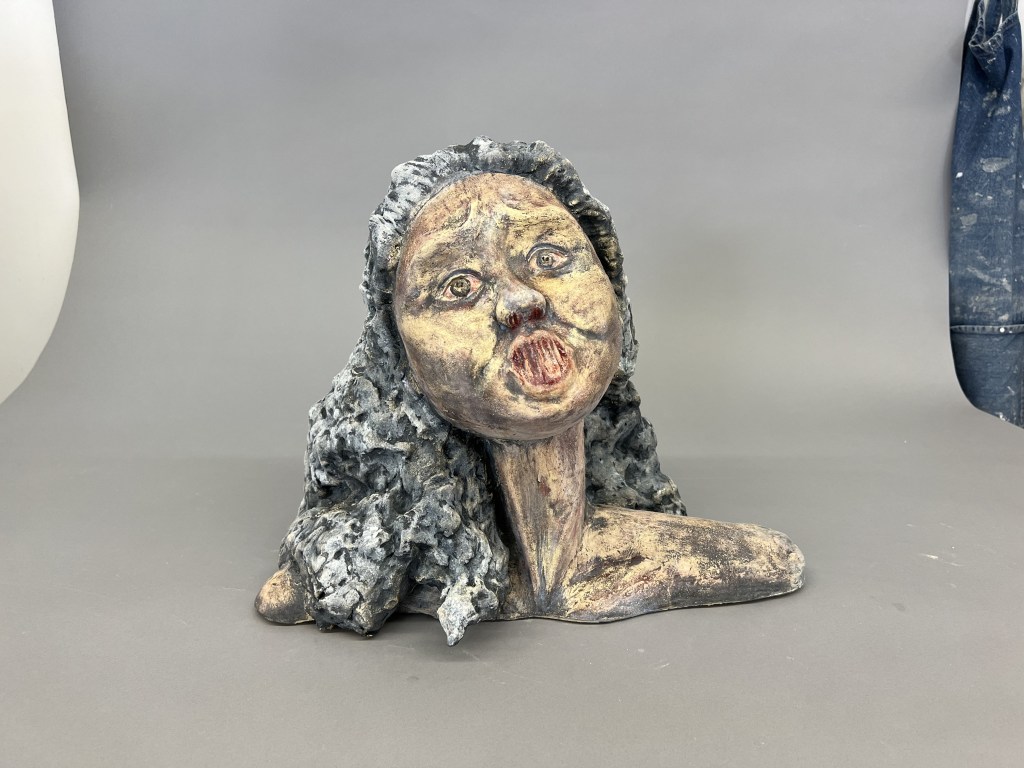
  • I would be remiss to write about other people’s art and not have the balls to share my own. this is my series that I created in spring of 2022 entitled rape of the earth. all pieces completed with glaze on ceramic.

    ecofeminism n.
    a movement where in a connection is seen between degradation and exploitation of the natural resources of the earth with the oppression and suppression of women. an intellectual critique of the confounding consequences of patriarchy and capitalism.

    battered and burned
    producing motherhood
    wasted tears
    suffocate me

    in addition to pointing out the ways in which the effects of climate change disproprotionately affects women, ecofeminism calls us to understand how our ontological feminization of the earth has framed and, therefore, justified human beings’ degregation of the earth. think first to the gendered language we have used throughout history to characterize our philosophical relationship with nature: virgin land, fertile soil, mother nature, conquest, domination. this gendered paradigm has separated the world of man (which is rational, scientific, modern, measureable) from that of the non-human (which is irrational, mystical, timeless, emotional).

    we are not merely a part of the natural world. we are not mere animals. we are man, created in the image of god. we are entitled to the earth’s resource. we are entitled to her fruits.

    consequently, society’s capacity for patriarchy is weaponized to extend our capacity for degredation of the earth. those familiar with the feminization of the Orient will recognize this same weaponization being used to justify colonialism and white supremacy in the years of empire and Orientalism.

    these pieces attempt to capture the parallels between these two paradigms: patriarchy and human supremacy. just as we are okay with seeing women’s bodies as vessels for abuse, reproduction, and neglect, we turn a blind eye to humanity’s exploitation of the earth.

    recommended readings:
    Feminist Environmental Philosophy, Stanford Encyclopedia of Philosophy, 2015.
    Ecofeminism Explores the Relationship Between Women and Nature, Leah Thomas, Teen Vogue, 2022.
    Women…In the Shadows of Climate Change, Balgis Osman-Elasha, United Nations Chronicle.
    Ask the Beasts: Darwin and the God of Love, Elizabeth A. Johnson, 2015. (tbh this one is only marginally relevant to this topic but it’s a really beautiful book on theology that introduced me to the concept of ecofeminism from a really beautiful class entitled “Religion, Science, and Technology” and I highly recommend it)
    The Ministry for the Future, Kim Stanley Robinson, 2020. (not about ecofeminism but I recommend this book to literally everyone who breathes)

  • art nouveau
    art nu-voh: new art
    n. an international french art movement characterizing the turn of the 20th century; a decorative style found in architecture, posters, interior design, glass design, and applied arts; characterized by sinuous, sculptural, organic shapes, arches, curving lines, and sensual ornamentation.

    also known as jugendstil in german, stile liberty in italian, modernisme in Catalan, and modern style in english.

    it’s a post-industrialized society. we’ve jumped head-first into the turn of the century and we’re past the point of no return. now, it’s a matter of figuring out what to do with this new world we’ve created. it’s a time of unprecedented accessibility in communication, mass migration between cities, democratization of institutions, and international political turmoil.

    what else is one to do if not create art? it’s the roaring twenties, baby.

    these were the conditions in which the world saw the rise of art nouveau. in paris, what started as a steady and experimental drip of inspiration from the studios of artists and architects quickly turned into a flood of ideological, social, and political sentiments that resonated profoundly with the masses. this stream spread at a rate that could not be matched by a force any less powerful than art. 

    art nouveau is the art style without a style. it’s art for the sake of aesthetic. aesthetic for the sake of beauty. purely eclecticism made for purely the masses. 

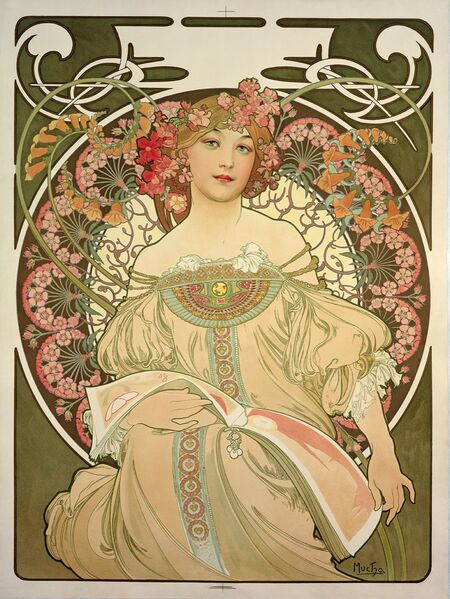
    Alphonse Mucha, Rêverie, 1897.
    iconic poster illustration of woman in floral headdress in le style Mucha, inspired by japonisme
    Claire Silver, Page 388, AI Art is Not Art, 2022.
    created using Artbreeder, Prosepainter, Collage by Studio Morphogen, Midjourney, Diffusion, StabilityAI, and Dalle2, as well as handpainting and digitally collaging where needed for cohesion

    following the industrial revolution, hordes of families are moving away from the familiar rural towns and farms that previous generations had known for all of precedented civilization. assuming their new roles as factory workers, these laborers create their new homes packed like sardines into apartment buildings in flashy urban cities. the trees, oceans, bears, lambs, forests, birds, and insects that once filled their lives are now nothing more than a distant memory. the field of grass we once frolicked through is now a foreign metro station made of iron and steel full of humid air and dirty bodies. the old world is gone—we are in an era of modernity.

    it’s the artists, then, who begin to acknowledge a certain feeling of longing. the artists who recognize the need to replace the natural and organic world that once filled our days with a new form of beauty. a need for new art. 

    in these unfamiliar concrete jungles, we see the emergence of decorative organic elements sprinkled in every parisian avenue. morale rises as we begin to see iron vines wrap the sixth floor balconies of the handsome sandstone apartments, advertisement prints imitating the bright colors of a sunrise in every magazine, and metro stations adorned by the wings of an abstract glass insect. it’s the nostalgia of everything we once knew—but beautiful. art is everything, everywhere, all at once.

    and this is no coincidence. you see, we’re living in a new era. viva la revolution and cheers to the end of monarchy. in this new democracy, society belongs to the people. art belongs to the people. in the old world, it was the bourgeoisie who could enjoy the grandiose renaissance paintings of gods and christ and war and napoleon and king louis and pampered puppies. in art nouveau, it is not the subject that matters, but the people who see it. art is to be consumed on the street, in the cafe, and in the metro. aesthetics don’t have to mean anything—it’s about our emotional response to the experience. 

    mass communication, industrialized production, integration into people’s daily lives, and user optimization—sounding familiar? 

    Hector Guimard, Le Castel Béranger, 1898, Paris, France.
    the first art nouveau building in paris. front gate to the apartments made of iron and composed of the quintessential art nouveau arabesque line.
    H01 & DeltaDauce, Artificial Pathways, 2022.
    created with Stable Diffusion

    fast forward one hundred years—our interactions, conversations, and experiences are characterized by our relationship to technology. just when it seemed like we couldn’t get any further from the natural world, the internet made it wholly unnecessary to have in-person interactions with one another in order to go about our daily lives. whereas we once took our positions in the factory lines to do our menial tasks until it was time to return home, we now stare mindlessly at our screens and respond to flashing bright stimuli. 

    nevertheless, can you think of an act more revolutionarily democratic than the internet? the blockchain was founded on ideas that would make the french revolutionaries weep with joy. 8 billion other people in the world who are suddenly accessible at the tap of our fingers. we consume more art today—in the form of photography, music, graphic design, advertisements, videos, and poetry—than our predecessors could ever dream of. by just downloading a few programs and clicking a few buttons, we can have an entire art studio on our phones. the creation of this art comes so naturally it feels almost instinctual. as if we are craving some form of beauty.

    it makes sense that—despite all of the groundbreaking developments that have been made in the field of artificial intelligence over the past few years—it’s not the language models or deep learning machines that are grabbing the internet’s attention. it’s the art.

    artificial intelligence doesn’t need to be making art. in fact, it shouldn’t be. it is wholly irrational to be using the energy of these supercomputers for the purposes of aesthetic. and, yet. here we are. art for the sake of art.

    Gustav Klimt, Adele Bloch-Bauer I, 1907.
    characterized by precisely linear drawing and the bold and arbitrary use of flat, decorative patterns of colour and gold leaf
    Claire Silver, Page 336, AI Art is Not Art, 2022.
    created using Artbreeder, Prosepainter, Collage by Studio Morphogen, Midjourney, Diffusion, StabilityAI, and Dalle2, as well as handpainting and digitally collaging where needed for cohesion

    what’s interesting about AI art is that it is fundamentally emotional. yes, there are some technical skills you need to produce something worthwhile (how to craft the perfect prompt inputs, understanding the different models’ training, extending and painting to refine the pieces, etc.). but, fundamentally, it’s not a matter of how well you can create. it’s about the artist showing us what they want to create. in an age of swiping, blocking, and ghosting, AI art calls our attention to relationships. allow me a moment to elaborate.

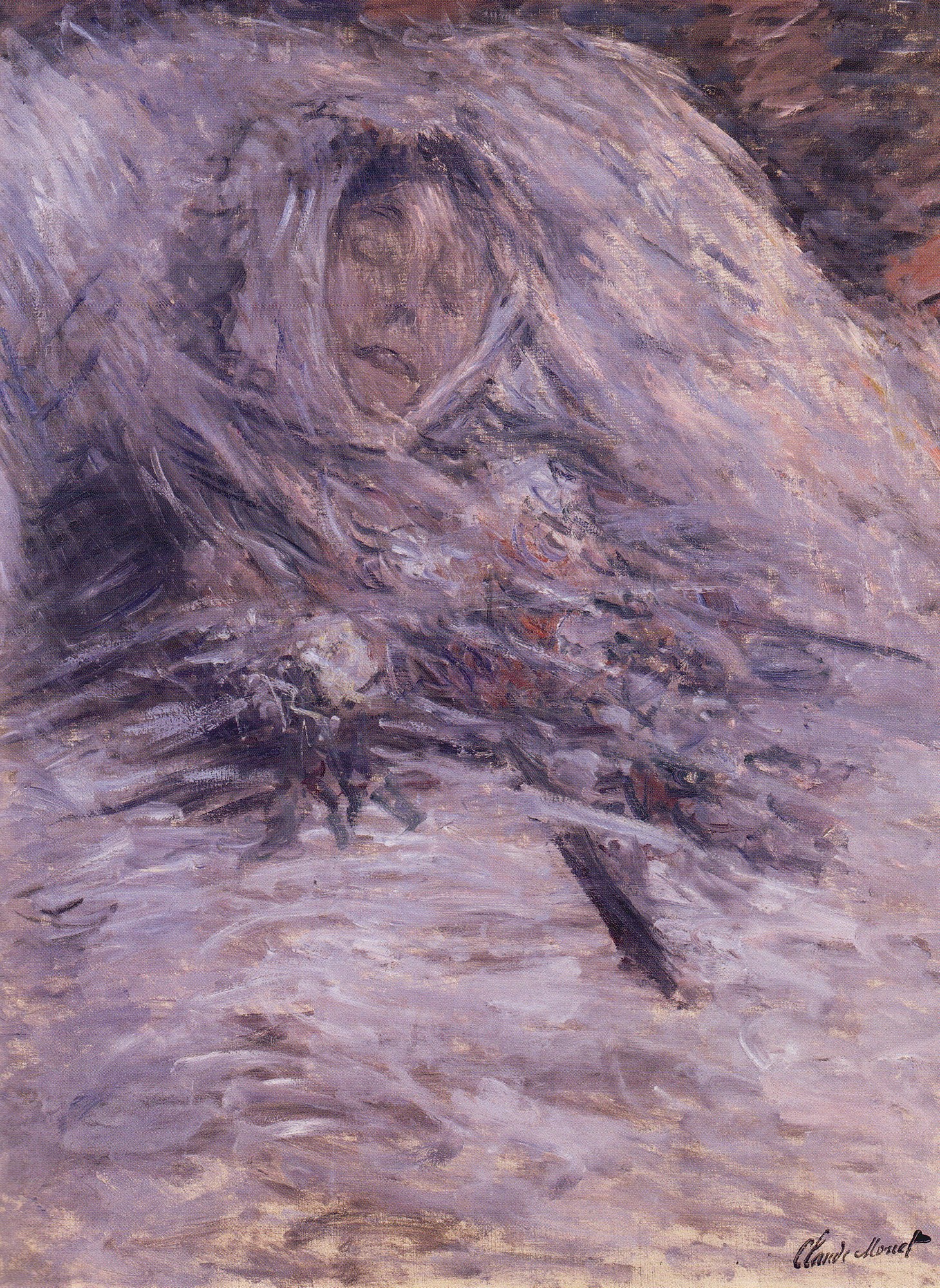
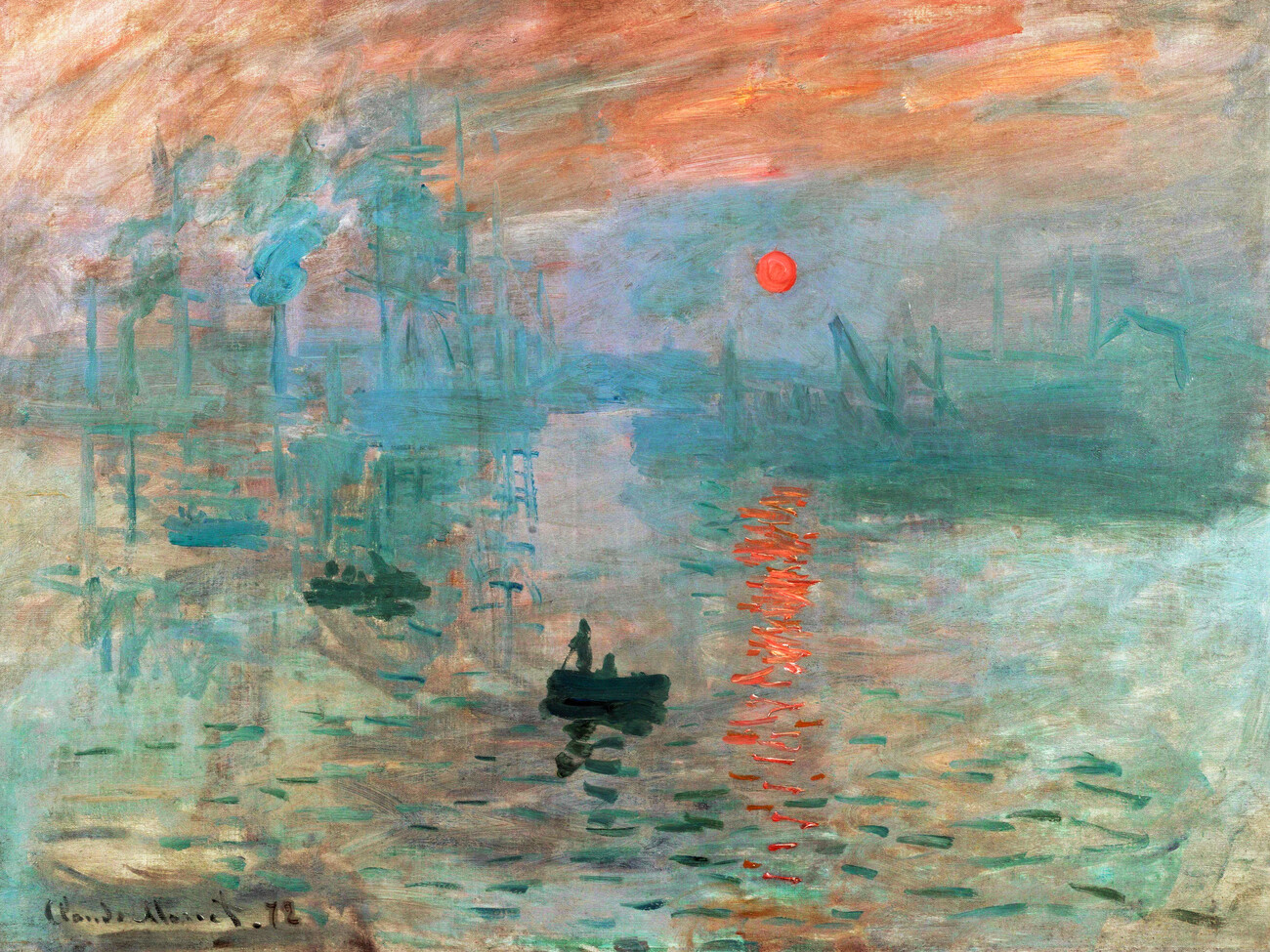
    one of the most quintessential art styles to emerge from art nouveau was the impressionist movement. you know it—think monet’s garden and water lilies, degas’ backstage paintings of the ballet, renoir’s depiction of a bustling courtyard. these artists were not creating the grandiose paintings of kings, queens, and gods meant to be consumed by the royals and aristocrats. nor were they interested in creating pristine lines and portraits. no, these artists were concerned with something much more sensitive: the first three minutes of daybreak when the sunlight begins to hit the fishing docks at dawn, the energy shared between four friends sharing a picnic illuminated by the dancing sunlight seeping in from the trees, the grief and anger experienced after the death of a loved one that came far too early. these moments in still time experienced by the average person that become the most important fragments of humanity one can hold onto in a post-industrialized world. critics called the muddled shapes and outlandish colors ‘immature’ and ‘unrealistic’—it was the end of art. the impressionists insisted otherwise: they were creating art that was not meant to be true to life, but true to emotion. the artists’ emotional experience of the process of painting. each raw paint stroke left still visible within the pieces demands the viewer’s attention, as if desperately calling out, “this is a painting! I am a painter! I painted this because I experienced this! can you feel what I am feeling?”

    it’s a moment that demands empathy. you are pulled in and invited to share this moment with the artist. it’s a relationship facilitated by the painting. how else could one communicate these human emotions of excitement and anticipation and loneliness and detachment and isolation? suddenly, the viewer is just as much implicated in the piece as the painter is. impressionism made it so that you didn’t have to be a gifted painter to be an artist; all you had to be was human.

    so, if impressionism calls attention to the relationship between (1) the artist, (2) the art, and (3) the viewer, then AI art calls attention to the relationship between (1) the artist, (2) the art, (3) the viewer, and (4) the computer.

    Claude Monet, Camille Monet on Her Deathbed, 1879.
    first wife of claude monet, subject of numerous paintings, mother of two before dying at the age of 32
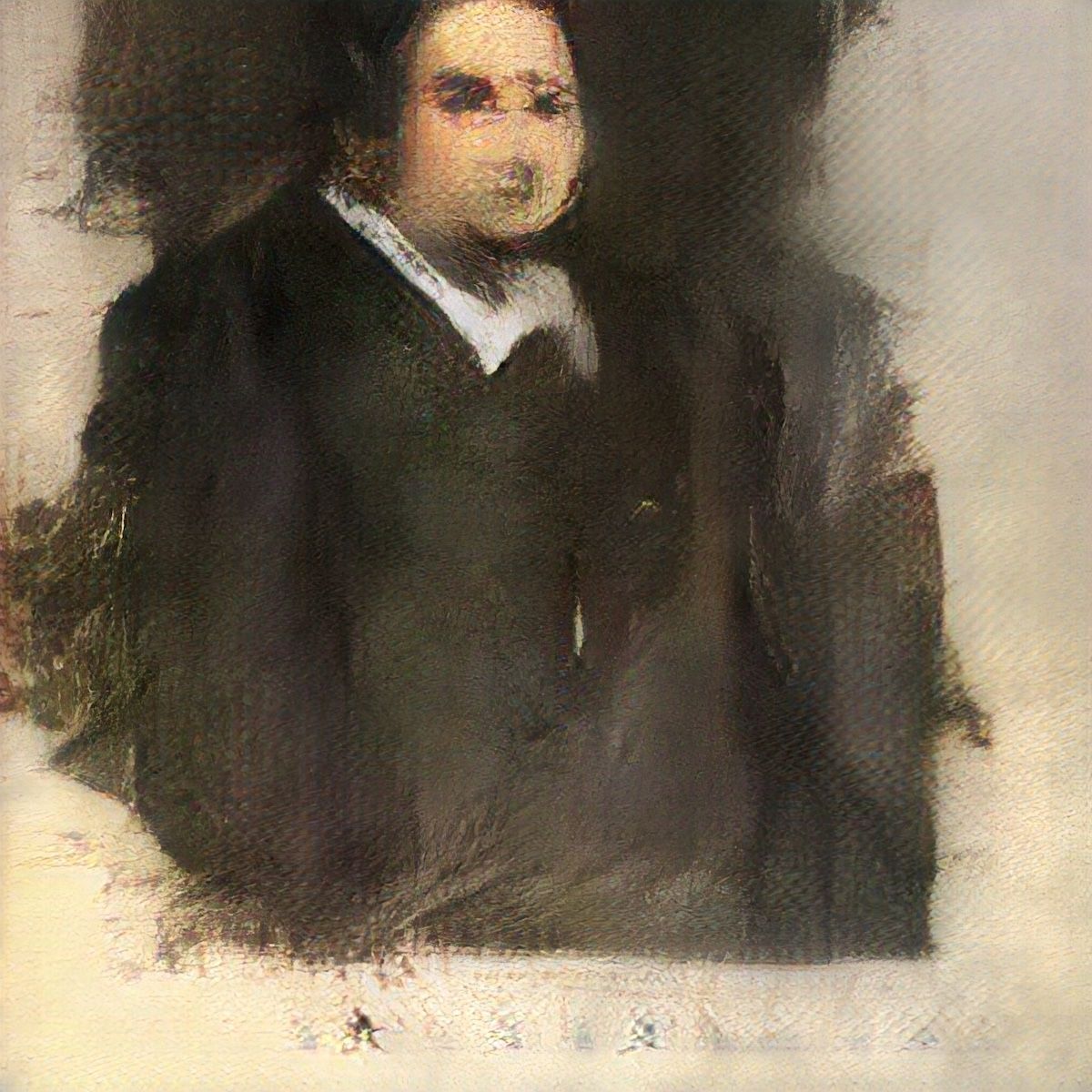
    Obvious, Portrait of Edmond Belamy, 2018.
    world’s first AI-generated painting by created by paris-based collective algorithm GAN’s (Generative Adversarial Networks)

    do you remember the first time you came across a piece of AI art? and I mean AI art—not some meme on twitter that made you giggle before continuing to scroll into infinite nothingness. no, I’m talking about the art that made you take do a double take. the art that initially filled you with a sense of denial because, no way a machine could create something as beautiful as that. did it make you feel uneasy? do you remember how your initial defensiveness turned into awe? the slow acceptance? do the you remember the excitement? do you remember how long it took for you to figure out the mechanics behind its creation? did you try to figure out which combination of words the artist had to stitch together in order to create something as beautiful as this? did you zoom in to try and find some kind of machine error or flaw? did you think about what kind of worlds you would create if you were given a machine that could create anything?

    and that’s just the thing. AI can generate anything. precisely because of this, the quality and subject of the art pieces only have enough appeal to temporarily catch our attentions. AI image generation is almost too easy. the hyper-realistic image generations can only be interesting for so long until they turn scary. the point of over-saturation is inevitable. we’ll soon tire of the images that look too much like the world we already know because these machines are quite literally incapable of coming up with their any of their own original ideas.

    it’s the creativity of the artists, then, that excites us. AI art does not try to hide the fact that it is computer-generated. what actually makes AI art so interesting is the process of making it. it’s not how well you can paint—or, in this case, how realistic the image generation is. it’s about the humans behind it: the dialogue between the artist, the art, and the computer.

    first, the artists’ dictations guiding the creation of the piece are the initial confessions we get to hear: what new world is this person imagining? next, the AI’s outputs give us insight into what it knows about us through reinforcement learning: how does this computer understand our world? our emotional response to the aesthetics of the piece puts us in dialogue with the artist: can I share this other person’s fantasy world? finally, our cognitive response to the piece—acceptance or denial—indicating our relationship with technology: how much do you trust this machine’s interpretation of our new worlds?

    in the same way that impressionism and art nouveau give us the opportunity to step into the imagined worlds of our artists, AI art allows us to take a peek into the emotional inner workings of both our artist and the machine.

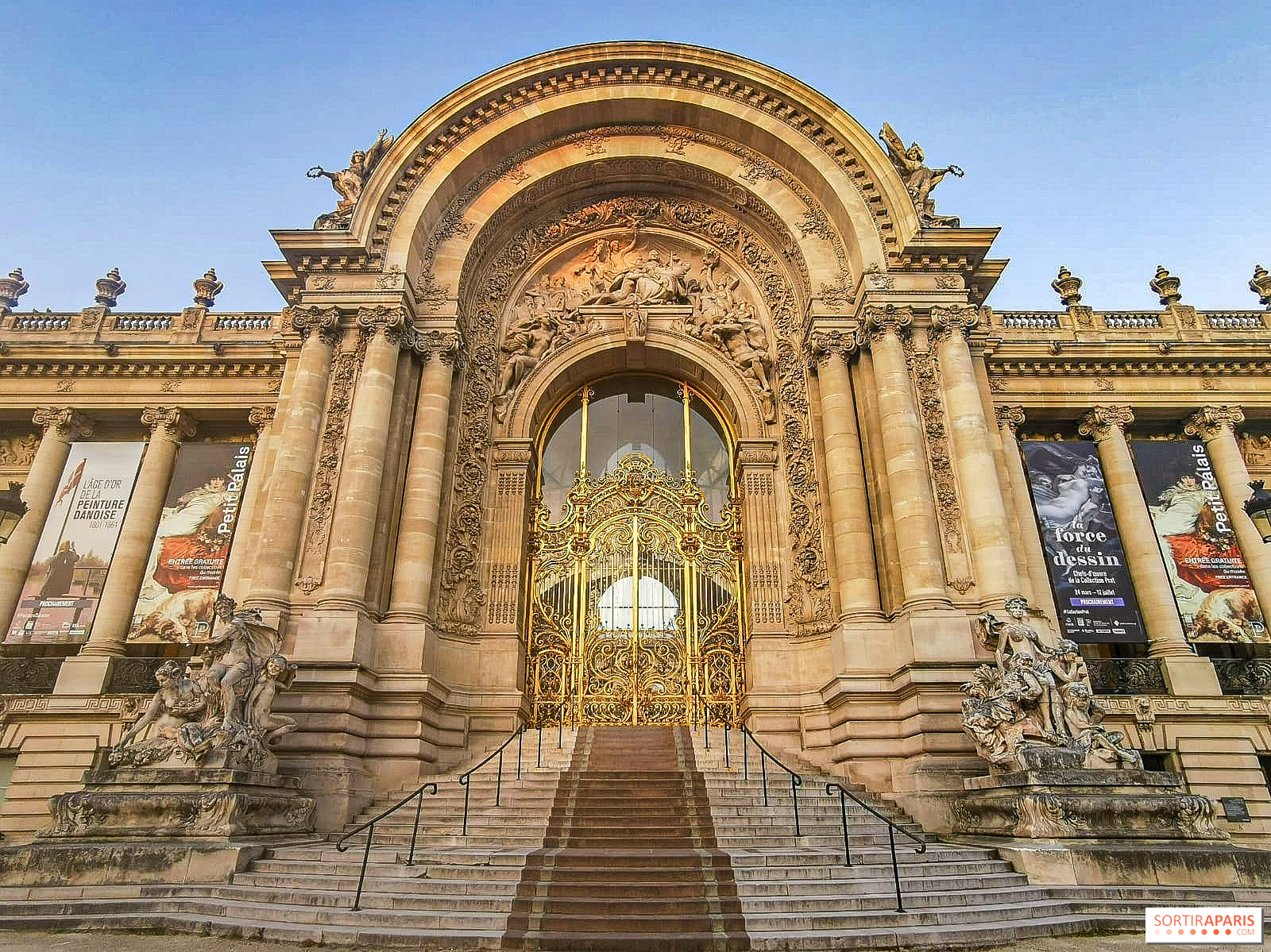
    Charles Girault, Petit Palais, 1900, Paris, France.
    art museum constructed in concrete, iron, and glass for the 1900 world fair in paris

    it’s a tad scary. terrifying, really. every bit of media you consume relating to artificial intelligence warns you of how these bits of code are going to steal our jobs and the dangers of forming para-social relationships with the personal assistants coded into our phones. then, of course, there’s the fear that these computers are going to become sentient and overthrow us or, at the very least, leave us subject to a host of ethical ramifications. 

    but I think that these fears are exactly why AI art is so appealing to us. amidst an evolution of technology that seems so foreign—almost threatening—AI art tells us that there is beauty to look forward to. that this is, in fact, a new way to connect with other people. a new way to have relationships. it’s different from having a conversation with a language model or watching a computer solve an unsolvable math equation. it’s not trying to be human: this application of artificial intelligence enhances the relationships that human beings can have with one another, rather than replacing them. we can share in beauty and art together. we can share in our emotional responses together. just as art nouveau made the concrete and industrialized world a little more comforting, AI art makes the new digital age a little more human.

    so maybe AI art is a coping mechanism of sorts? a more palatable and beautiful way of letting artificial intelligence into our lives? (are we the crabs in the pot letting ourselves get slowly boiled alive? have we filled the pot and turned on the stove ourselves?)

    well, I hope not. we can only hope that it becomes more that. we can only hope that this paradigm becomes the ideological model for how we continue to gradually let AI into our lives: as a mechanism to enhance our relationships with one another, not replace them. we can only hope that we will soon enter world where people and machines can still be differentiated by one fundamental value: human creativity.

    I will be the first to voice the many valid criticisms against AI art (namely, my disdain for the anonymity, appropriation, monetization, and unoriginality that has taken place within field). but I don’t think that these criticisms are quite enough to write off the entire medium. AI art is what will keep us hopeful for the future. we are craving this beauty. we need it. without it, we may just (1) spiral into a descent of pessimism and fear for our future or (2) lose all agency and humanity in this new digital age. and you have to admit, the pieces are breathtaking.

    if AI artists are willing carry out this work with intentionality, authenticity, and vulnerability, I will remain hopeful for our relationship with technology. if we are willing to remain creative and empathetic, AI will be able to bring more beauty into our lives. we’re already in the midst of it. now, it’s just a matter of being brave enough to take control.

    it’s art nouveau. it’s the roaring twenties. and it’s time for new art. 

    Claude Monet, Impression, Sunrise, 1872.
    the mist of a hazy sunrise in a french harbor; considered one of the most prominent impressionist paintings of all time
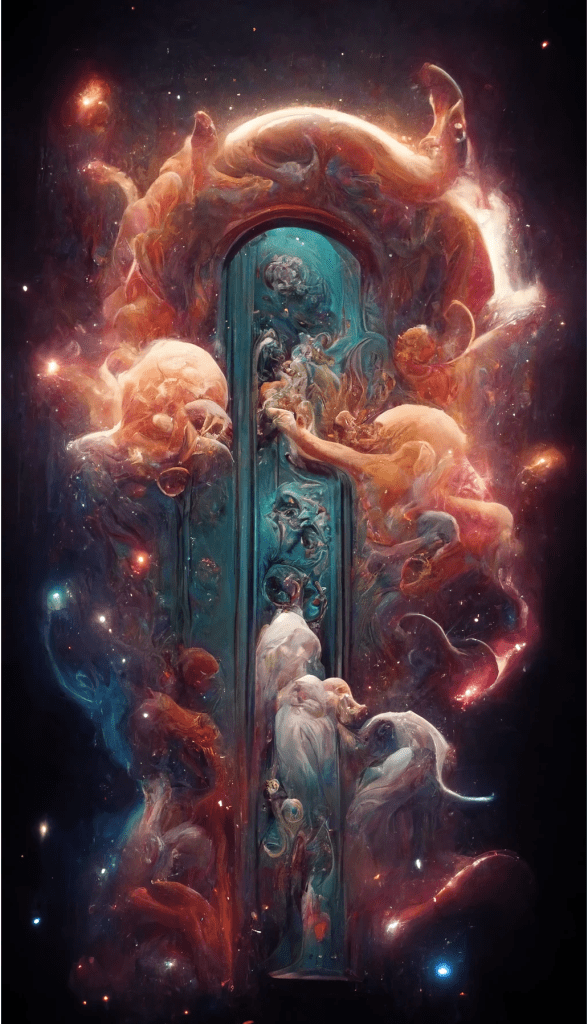
    James M. Allen, Théâtre D’opéra Spatial, 2022.
    created with MidJourney, winner of colorado state fair digital art competition
  • sonder. n.
    the realization that each random passerby is living a life as vivid and complex as your own, in which you might appear only once, as an extra sipping coffee in the background.

    I love new york city. really, I do.

    the rush of hot wind that warns of an incoming subway train, the sound of jazz filling in the lulls of the conversations taking place on each street corner, the sweaty surrender to the humid air as you accept a state of frizzy hair and shiny skin. i am personally partial to the vibrancy of the cultural enclaves that have stubbornly found a home in this mammoth of a city. (I may have been four years old the last time I stepped foot on asia but as soon as I breathed in the air of flushing’s chinatown, the smell of the vietnamese street markets came back to me as vividly as times square). it’s a city that has always enchanted me—from a distance and as a visitor.

    I spent the past weekend visiting friends in new york. as expected when you combine quality time with quality people, it was a delight. the trip was packed full of incredible sights, food, drinks, and memories. between each of our escapades, we navigated the city’s winding subway system—alongside the 2 million new yorkers who utilize the trains each day.

    I personally experience sonder in my life quite a bit. to be honest, it’s an something (an emotion, acknowledgement, realization—whatever you want to call it) that brings about significant discomfort. not necessarily in the recognition of the fact that I am nothing but a small and insignficant part of our society and the rest of the universe (though this is terrifying in and of itself). rather, it’s the contemplation of complexity and nuance in the lives of others: the acknowledgement that each human being I pass by on the street, stand behind in the grocery line, wait alongside in traffic, or read about in an obituary has had an experience of life that is just as deeply complicated and overwhelmingly emotional as my own.

    sonder invokes within me an intense experience of empathy—or, it would be more accurate to say, an attempt of empathy. for how could I possibly even begin to understand the life of a stranger I know nearly nothing about? how could I possibly even begin to imagine the lives of 7.7 billion other humans in the world?

    while paralyzingly uncomfortable, I think sonder is an important thing. it’s what reminds us that the people we interact with are people. it reminds us that we are part of the larger community of humanity. it reminds us that strangers experience heartbreak, joy, sadness, jealousy, pride, shame, and dreams. it reminds us to have empathy and compassion for strangers simply for the sake of them being human, too. it’s what keeps us human.

    while riding the subways in new york, I couldn’t help but feel emotionally overwhelmed. I struggled to pinpoint exactly why, at first. my friends and I loudly laughed at our own jokes and excitedly told each other stories as the packed trains bustled from stop to stop. each time the conversation lulled and I took the opportunity to look around the train car, I experienced a moment of deafening silence. I became struck with a familiar discomfort; suddenly, we all became cold strangers. everyone in the train avoiding eye contact and pretending that we weren’t occupying the same space.

    in a city with 8.38 million people, sonder becomes a liability. to imagine that the woman with her hair wrapped in a turquoise scarf sitting in tired silence with her eyes closed in the corner seat of the e-train on her commute from work is returning to a lonely and empty apartment. to think about the years of physical labor that formed the callouses on the hands of the man gripping onto the metal pole on the c-train with a exhausted look on his face. to get a tiny glimpse into the anxieties, excitement, and insecurities embedded into the all-important social life of the high school brunette dressed in a purple sequin dress on her way to a school dance with her friends. to pretend to know the story of the chinese grandmother dragging her cart filled with a technicolor array of plastic bags, printed notices, aromatic fruits down the steps of the m-train station. how could you not be overhwelmed with emotion?

    while taking a moment to appreciate these brief displays of humanity can be heartening, the sheer amount of people you interact with on a daily basis in new york makes this nearly impossible. just one stroll down one avenue during daylight hours means sidestepping and sharing a walkway with at least 35 other pedestrians. waiting at a stoplight and contemplating the timing of a strategic and artful jaywalk can mean sharing the risk with 20 other strangers. assuming that your subway car is only ever filled at half capacity, that’s another 100 potential people sharing your commute to work (and that’s not even considering the people coming in and out on each stop and taking multiple trains). in a typical day, the average new yorker could easily interact with over 500 strangers they may never see again.

    with a life so filled with life, how can one be expected to still have empathy? we simply see too many strangers to still have the ability to feel emotions for them. when you look around the train car, people will be sitting side by side fully squished up against one other, but will be actively looking down at the ground and avoiding eye contact. no one would dare strike up a conversation or even attempt to acknowledge the incredulity of the physical situation they are in. it’s so comical, you could almost laugh. it’s easier to pretend that the person physically next to you does not exist than it is to momentarily acknoweldge their humanity and interact with them as such. mutual dehumanization is an inevitability.

    and this is not an attempt to knock new york city. far from it. in fact, I think new yorkers’ have done a beautiful job of compensating for these lapses in humanity by placing emphasis on creative nonverbal nods to individuality: fashion, art, political movements, music, dance, and the stories fed to us by the countless romantic comedies that take place in the big apple. (but part of me cannot help but suspect that these displays of intense individuality are just more cries into the void: “see me! notice me! I am human! I may be one of 8 million but I am unique!”)

    but I digress.

    rather, this entry is an attempt to explain a larger trend in our society’s development towards this default state of dehumanization. over our species’ history, we made the steady trek from small tribes of 100-200 community members in which everyone knew each others’ names to the modern day where we share towering concrete jungles with millions of other faceless inhabitants. we no longer have our small communities. our monkey brains, however, have stayed the same (because to think that our evolutionary biology has kept up with the growth of human civilization is far too optimistic for me to believe). our brains were not built to keep and maintain relationships with our 1,500 instagram followers. our brains were not built to function in communities made up of 8 million other people. our brains cannot even conceptualize what 7.7 billion people on earth looks like, let alone how to have empathy for those 7.7 billion people. despite there being more people on earth than there have ever been before, we feel more lonely than we have ever been before.

    our empathy is limited by our biological facilities. if we cannot even acknowledge the humanity of the person with which we are rubbing shoulders against on the subway, how can we be expected to have empathy when we hear of a genocide where actual human lives are being taken taking place across the globe. it’s simply far too much.

    I fear that we will be perpetually dissatsified by our inability to adequately express our fondness and empathy for one another. i mean, that’s ultimately what bothers us so much about the feeling of sonder. we do not have the words to articulate the loneliness we feel in our own lives nor do we know how to communicate our longing to be in communion with others. there is no point in us saying to strangers, “it’s okay. I know you exist. I know you feel the same feelings that I do. I know you experience struggles I will never be able to understand. I cannot help you nor can I do anything about it, but I want you to know that I know.” sonder will leave you only more frustrated than when you first began to contemplate the existence of others. screaming into the void does nothing when you no one is able to adequately acknowledge your humanity either. dehumanization—the act of relinquishing our ability to experience sonder—becomes a coping mechanism to avoid this tragic fate.

    or not?

    maybe i’m just overly sympathetic. maybe i’m wrong about this. I hope i’m wrong about this. I hope that new yorkers can rebut me with stories about how they have been able to experience enough heartwarming experiences of humanity and empathy to counteract this default state of dehumanization. that people surprise me with how much empathy and joy they can share with complete strangers. that our society operates with a love ethic to encourage social justice and good will of all populations. that we can build small communities where each person knows and cares for their neighbor. that sonder stops being such an uncomfortable feeling because we have the privilege of being in the company of one another.

  • I grew up on paris by night and heineken. I took my first steps in a basement that hid a secret double life as a karaoke bar. I knew neon flashing lights and the sound of a microphone feedback before I knew the disney princesses.

    on whatever spontaneous sunday night the aunts and uncles were able to come home early from their shifts at the nail salon, restaurant, or casino, it could be safely assumed that the night would end in wailing duets with beer devastatingly spilled onto the corner of the couches and neon lights flashing into revolving patterns across the dark room in tune with the music. the children would be fast asleep on the ground or in the laps of their parents who combed their fingers through their hair with one hand and held the microphone high to their mouths with the other. the screen would be lit up with music videos from a period lost in time taking place somewhere between the American 70’s and the Vietnamese 90’s (those familiar with the topic will know that these two time periods are not as different as they seem). the youngest aunts dancing along to the latest, sexiest global pop sensations minh tuyết and trish while the grandfathers croon to an old song about being separated from their first love by the seventeenth parallel. our families greedily clung to these cultural artifacts like they were their life source. their last hope of keeping their rope taut to their country, one whose aquaintance they have not known since the 1975.

    imagine! the country where they imagined spending their entire lives: where they fantasized their high school experiences, their wedding engagement, their firstborn child, their first kiss, their last kiss. a future envisioned but dissipated after 1975. I mean, what is it to even imagine a life outside of your own country? to suddenly be told that you were to live in the united states. to entertain the potential that, one day, you may never return to the home of your mother and grandmother and great-grandmother. to enter a world you only knew in overheard rumors and half-truths. to raise a child in a society you only knew through through guarded defensiveness and jaded disappointment.

    but I digress.

    oh, but what an artifact to have: karaoke. a wonderful thing, really. not quite art and not quite performance but entirely an experience of joy. what a most genuine feeling to have. to exist with your family and want to create entertainment with one another for one another. and how can one help but sing when your language is made alive by soaring and dipping tonal variations that reverberate the walls (so dramatically different from the drawling monotone repetition of english). what a perfect nostalgic escape. an emotion I cannot even begin to imagine: to be homesick and heartbroken for your country. heartbroken as if it were a lover you were separated from for no logical reason other than identity and war and politics and borders and wealth and poverty and—

    the vietnamese are a prideful people—not one to admit that they miss the country they were forced out of. it’s arguably much easier to sing your laments about the loss of a lover.

    for anyone unfamiliar with this era of 2000s vietnamese media, let me elucidate the scenario. you see, when your country has a communist revolution and your people are on the losing side of a civil war and forced to relocate to different pockets of inhabitation across the world, consuming the music of the people who kicked you isn’t exactly appealing… but how can you keep from singing? in 1983, vietnamese parisian immigrant tô văn lai sought to fill this cultural void experienced by vietnamese americans brought about by the diaspora. with other refugees in france, he created paris by night: a variety show complete with musical performances with flashy dancers, sketches reminiscent to the era of vaudeville, orchestras featuring the stylings of a guqin, and a cast of stars who have become household names familiar to any young vietnamese american. the direct-to-video episodes entered the hearts and homes of vietnamese refugees across the seas as they churned out over 130 (and counting) three-hour-long episodes the course of 30 years.

    117th installment of paris by night, filmed in orange county
    beloved show hosts nguyễn ngọc ngạn and nguyễn cao kỳ duyên
    paris by night 121 poster

    the only hints of the american occupation’s violence were the dancers dressed in costumes resembling american soldiers running across the stage. the only indications of colonialism’s scraping of culture were the romantic trumpet entrances to the love songs composed in the style of french sonnets. the only images of agent orange’s devastation were the commercials that flashed between songs that called for donations to the orphanages housing the thousands of children born with birth defects as a result of american bioterrorism.

    my family still sings these songs today. I still sing these songs today. when I perform them at the vietnamese senior center’s karaoke social, the elders praise me for being such a great vietnamese singer, despite being american-born. but I don’t sing lyrics in vietnamese; I sing in the lyrics of the vietnamese diaspora. I can’t help but wonder what my participation does to the legacy of american occupation. what connection do I really have to my culture if the only one I know is defined by opposition and heartbreak?

    this fall, I will be studying abroad in paris. I will be going to the site of this vietnamese american identity’s conception. I hope for the opportunity to one day determine what the diaspora means to me, what the lingering whispers of american occupation are saying to me, and what paris by night looks like with my own eyes.

  • adj. to be nosy; having a big mouth; to be talkative or to have a liking for gossip.
    direct translation: many stories.

    for most women in our so-called post-feminist new age, the sentiments articulated in Virginia Woolfe’s “A Room of One’s Own” are intuitive. whether the discourse is taking place within the sterile walls of academia, begging for attention in the latest issue of teen vogue, or isolated to an interaction between two strangers in the comment section of a tiktok video, Woolfe’s message is clear: a woman’s freedom is intrinsically tied to her means. in order to cultivate art, love, life, and ownership, a woman must have a room of her own. that is, economic independence, leisure time, technological access, education, or bodily autonomy.

    you can’t write fiction without having the time for introspection and free thought. you can’t create sculptures without having access to a $2,000 kiln to fire your pieces in. you can’t be a dancer if your feet are worn out from nights of taking on extra shifts at the restaurant. one’s stream of consciousness cannot be plagued by the demands of a crying baby or cut short by the customer calling you to their table for the fourth time during your midday rush.

    art requires time. art requires patience. art requires the means. art requires a room of one’s own.

    what I love most about this visualization of having a room of one’s own is the implication of space. that is, the physical space encompassed by a room of one’s own; the idea of taking up so much space that an entire room is filled to the brim with my overflowing stream of consciousness. a room where i can dance and sing and leap and scream and wail and cry and mourn. it’s exhilerating, really. that these walls propped up can only barely confine the wildness that is my being within its bounds.

    what is being a woman if not being taught to take up less space? what is being a woman if not being taught to constantly be aware of others perceiving you? to consider what the others will say about you showing up to school looking like that? to put on longer pants because the uncles are coming over and do you want to look little slut? to fake an orgasm so that he gets the confidence boost he needs because he had a hard day at work? to please and accommodate?

    I am fully aroused by the thought of the seclusion and isolation that a room allots. the freedom to look at myself with my own eyes. but the same time, i am terrified. an entire world of potential hidden away behind a door that could give shape to either beauty or treachery. I cannot help but wonder about what types of thoughts I would have if I were truly given a room of my own. who am i outside of the watchful eye of the observer? what kind of thoughts would i finally have the courage to play with? what kind of selfishness and rage could i finally indulge in? what catharsis could i finally acheive? what characters within myself will I come to discover? with the space to do so, would i come out finally free enough to give voice to my anger? in this space that I create for myself, will I recognize the version of myself that I become? what sort of villain will they paint me as once I leave my room? what kind of art could I create?

    I have always been particularly excited by anger as an emotion; the rush, the power, the anticipation, the passion, and rawness that accompany it—the idea infatuates me. the emotion itself allures me. perhaps, because I have never been fully abandon myself to it—to give myself the space to surrender myself to an uncontrollable storm of rage. perhaps, because I look upon it from afar. perhaps out of fear of causing too much damage.

    the anger I hold simmers at a low heat. a constant but suppressed held breath. it comes in the form of pessimissm or cynicism or self-sabotage or imposter syndrome or internalized hatred or insecurity or—

    it’s an anger that i’ve held my entire life. it’s an anger that my mother held. an anger that my grandmother held. it’s an anger that was passed onto me by every woman in my family who was never given a room of her own.

    in vietnamese, we reserve the phrase, nhiều chuyện for our women. we tell our girls who ask too many questions that they need to hush. we tell our daughters that they must uphold certain responsibilities and that telling stories is not one of them. we tell our mothers that sharing their experiences of abuse will only jeapordize the rest of the family. we tell our women to be quiet and save face.

    and yet. we loudly sling gossip across nail salons and watch gleefully as they fly through the dust in the air from the nail files and land into the women’s eager ears. the piercing songs of cải lương that mothers wail to their children rock the babies to sleep at night. the tearful testimonies of months spent floating at sea without food and water escaping a war torn country make their way piece by piece into the minds of hopeful american children.

    what of our culture would still exist if not for our mother’s stories? if not for their courage to share their hushed truths? if not for their resilience in forging spaces for their families in this foreign and unknown land? if not for their insistence on decorating their new american homes with red lanterns and flowers each lunar new year? if not for their persistence in packing smelly thịt kho in our lunch boxes to eat at school before recess? if not for their entrepreneurial grit that created the Little Saigon’s and Lee’s Sandwiches of the world?

    in Alice Walker’s “In Search of Our Mother’s Gardens,” Walker pushes against Woolfe’s piece. if the production of knowledge and art necessitate a room of one’s own and money, how have generations of black women—who have historically never had anything close to the means Woolfe describes—been able to cultivate a legacy of art through music, storytelling, quilting, braiding, and crafting? these life-giving sources of beauty are the gardens our mothers planted when they were not given their own rooms. the most beautiful of lotuses that bloomed in even the swampiest of marshes. rather than waiting to be granted the optimal conditions to do so, they forged paths of resistance in order to create art.

    our responsibility, then, is to find these gardens and renew them. to recognize the scars of anger that are buried deep beneath them and seek out their justice. to tend to the wounds of trauma and plant seeds atop them. to actively create spaces for us to explore our personhoods, even when the world gives us a hostile response. to create art does not mean seeking out complete independence and isolation from the world—it is to honor the legacy we have grown from and create anew.

    my mother’s garden is made up of the painfully detailed and devastatingly tight braids she would etch into my hair every morning before school. it is the foam heart that she carefully pours into every cup of coffee she makes with her espresso machine. it is her song she performs with red-faced passion every time the aunts get together and sing karaoke. it is the arrangement she makes using the flowers she finds growing outside of our apartment complex. it is the precision with which she squeezes the limes drops into each daquiri she makes working late nights at the bar. it is every nail she hammers into the walls of her cafe to hang up the latest oversized landscape painting she stumbled upon while foraging through a garage sale. it is the nostalgia and reminisce that she shares with her sisters as they laugh over bottles of heineken and stories from their first years in america as catty high schoolers.

    when I think about what has kept me from writing—from taking part in the production of art and knowledge making that I have always distantly flirted with—it has never been about attaining the means. I have been more than lucky enough to have the platform, language, education, and resources to express myself. it has been fear. fear that I won’t write well enough, that I don’t have anything important to say, that I have nothing original to tell the world. when I think about these fears compared to that of my mother, who at 26 was left alone with two daughters in a country where she barely spoke the language, I cannot help but laugh at my own self-pity. like, please—grow a pair.

    arent our futile attempts at originality simply a denial of the influences that created us? a denial that we are our mother’s daugthers? to confess that I am wholly unoriginal almost quiets these fears and insecurities—I write from a long line of women with many imperfect, incomplete, and unoriginal stories. I can only hope to do the same.

    I am writing to tend to my mother’s garden. to write words she will never read but will have full ownership over. to share ideas that are as unoriginal. to have the courage to explore my own personhood. to share my opinions. to share my ambiguity. to share my rage. to share my love. to forge a room of my own. to share my many stories.